

While the number of vacant teaching positions in Illinois has gone down over the past few years, the severity of the persistent shortage of quality educators in rural areas remains as potent as ever. This is the mixed reality of the Illinois State Board of Education’s (ISBE) “2026 Unfilled Positions Dashboard.” As ISBE correctly notes, the sheer number of unfilled teaching positions (UFP) has indeed decreased substantially from last year across all geographies. The state’s historic Teacher Vacancy Grant and other grassroots efforts to inspire the next generation of passionate educators have played no small part in stemming the tide of unfilled positions.
However, a careful analysis of the data, both in context of the communities schools reside in and across time longitudinally, reveals a more complex story. Even though overall numbers appear to be improving, rural and town school districts are still struggling.
This chronic rural educator shortage is a core issue for the Association of Illinois Rural and Small Schools (AIRSS). The inability of Illinois’ nearly 500 rural school districts to find and retain educators is a direct threat to students’ ability to obtain high-quality skills and knowledge, and a detriment to long-term local social and economic vitality. Simply put, there is a direct line between a healthy, functioning public school district staffed by passionate and certified staff and the overall trajectory of the community. Obscuring the rural reality of persistent challenges in the teacher workforce hinders our collective efforts of serving all students.
There are a few major points to make in reviewing the most recent UFP data in conversation with local contexts and previous UFP datasets:
First, UFP is still historically high. Total UFP is still 38% higher than it was in 2022, just after the Coronavirus Pandemic, and 67% higher since 2022 in rural districts (Table 1). It is true that the trend of total UFP has declined since a recent peak in 2024, with a substantial reduction in the past year. Yet, we cannot let early signs of progress ease our alarm or slow our work for substantial, sustained investment into education. We should be encouraged by this most recent data, but it should encourage us to work even harder at rebuilding the prestige and impact of the education profession. As research from the Rural IL CTE Project has revealed, pathways into the education workforce at all levels remain rare, and the transition between high school, college, and career remains disconnected. Our sincere hope is that recent education pathway innovations are starting to take effect, but we cannot let one year of encouraging signs paint a rosy picture of a challenging situation.
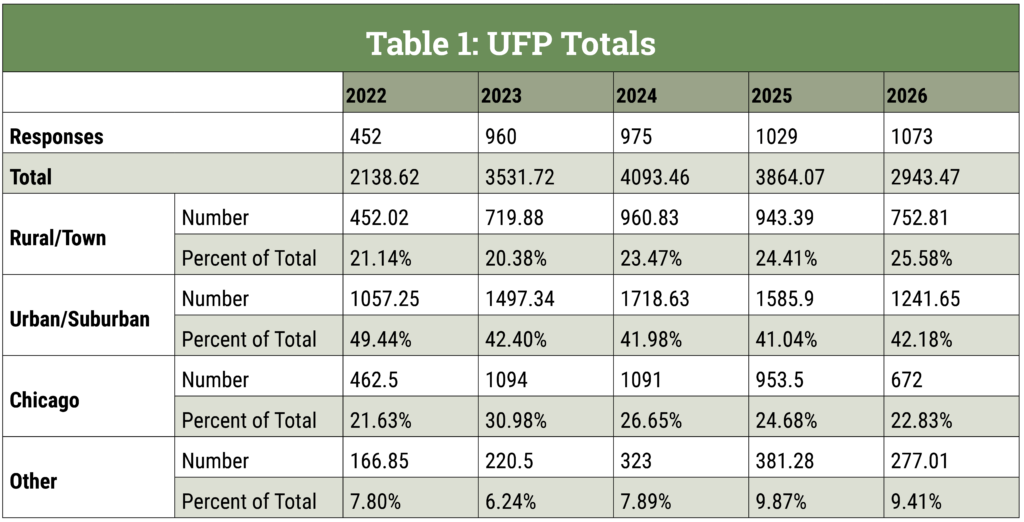
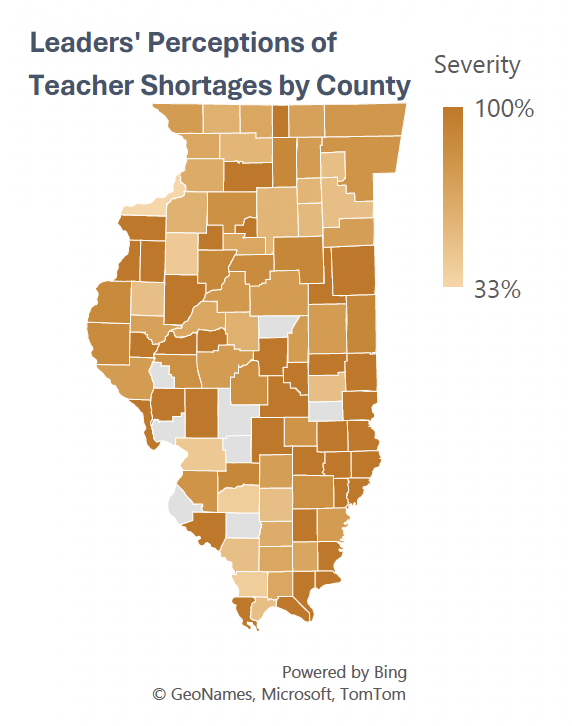
Second, the severity of unfilled positions matters greatly. In the previous two years, the Illinois Association of Regional School Superintendents has collaborated with ISBE to publish “Educator Shortage Reports.” These reports utilized the UFP datasheets produced by ISBE in conjunction with IARSS’ own surveys to school leaders. One of the primary assets of this combined approach was that IARSS was not only able to present UFP data, but also demonstrate the perceived severity of educator shortages among school leaders. This is an incredibly important data point because rural and smaller districts are more greatly harmed from a single unfilled position than larger and more urban districts (Figure 1). This is a perspective ISBE’s dataset alone cannot provide, and that we do not have for this year as IARSS did not produce a new report. While it is true that rural districts have significantly reduced their UFP this year on paper, the persistent impact of remaining unfilled positions at a historic high is deeply detrimental to students.
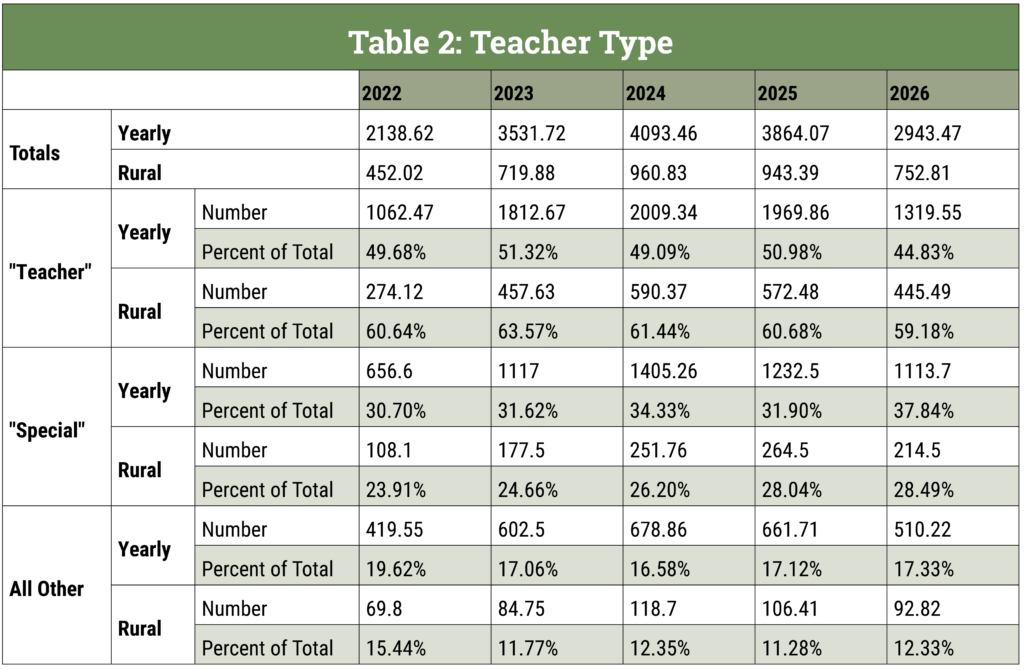
Third, the shortage of special educators has intensified. In the ISBE UFP datasheets, positions are classified into four groups: administrative, paraprofessionals, school support personnel, and teaching. “Teaching” is further classified into 20 subcategories. The single category “Teacher” represents nearly half of all “Teaching” UFP. The two categories of special educators, “Special Education Teacher” and “Bilingual Special Education Teacher,” comprise the second largest group of “Teaching” UFP. For 2026, “Teacher” and the two special educator types represent nearly 83% of total UFP (Table 2). Reviewing these details, the UFP of the “Teacher” category has decreased as portrayed in ISBE’s recent newsletter. However, the share of special education UFP has continued to increase over time. This suggests that while we may have burgeoning systems for filling traditional teaching positions, our pathways into special education remain limited. The severe shortage of special educators in rural areas is especially cutting, as the IARSS’s “2024-2025 Educator Shortage Report” (page 11) reveals.
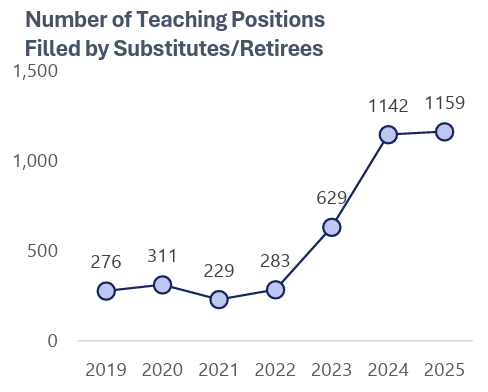
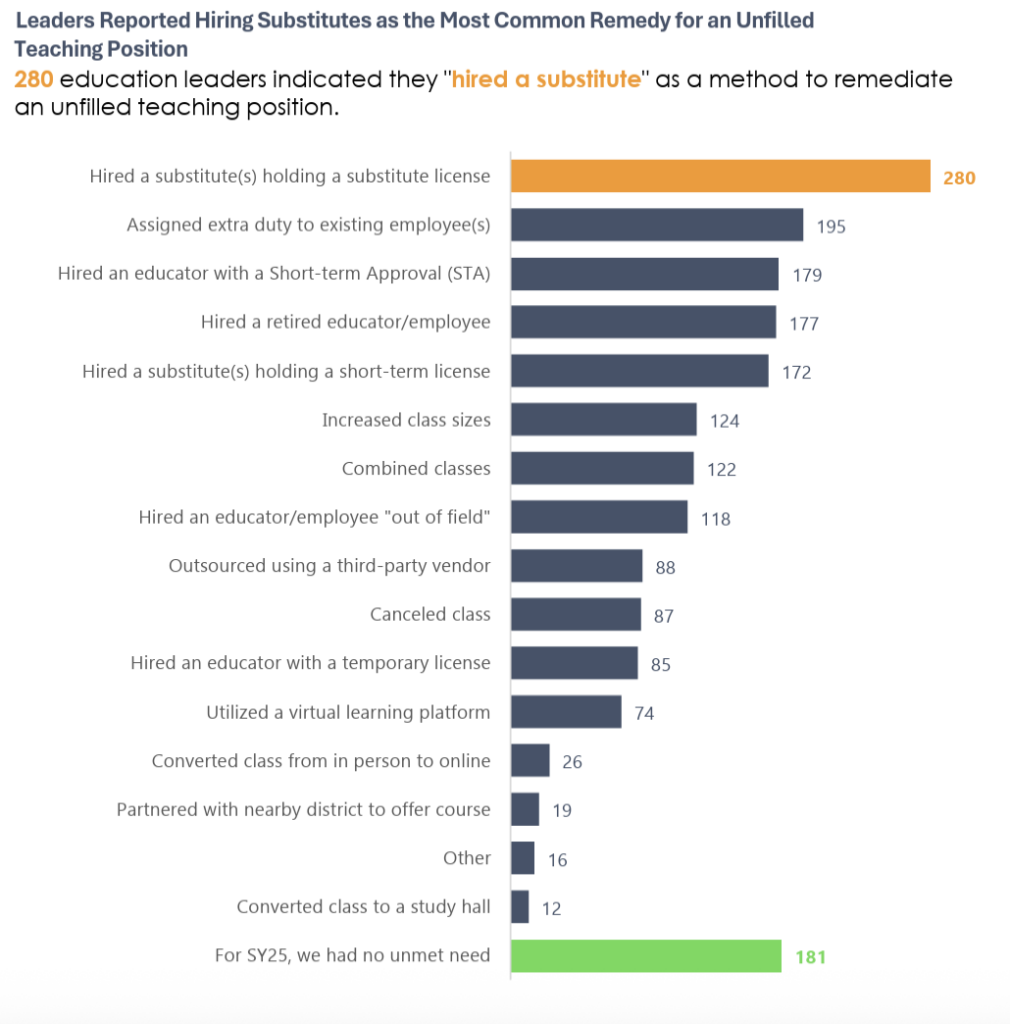
Fourth, we do not know the credentials of the individuals who filled open positions. Another critical metric that the IARSS Educator Shortage Reports tracked was the methods districts employed to fill open positions (Figures 2 & 3). This was a critical data point because it revealed that many districts, especially those in rural areas, relied heavily on long-term substitutes, retired teachers, and alternative or temporarily licensed individuals to staff chronically unfilled positions. Without further detail in the 2026 datasheet, the reduction in UFP simply becomes a “filled” position. A warm body, regardless of their good character or love for children, does not constitute a high-quality resolution. The most recent IARSS Educator Shortage Report revealed that a substantial number of rural districts relied on alternative measures for filling open positions. Taken within the context of alarmingly poor NAEP test scores, which show our children slipping further behind despite the fact that we are supposedly succeeding at “filling” open positions, the necessity for understanding the quality of individuals filling open positions becomes imperative.
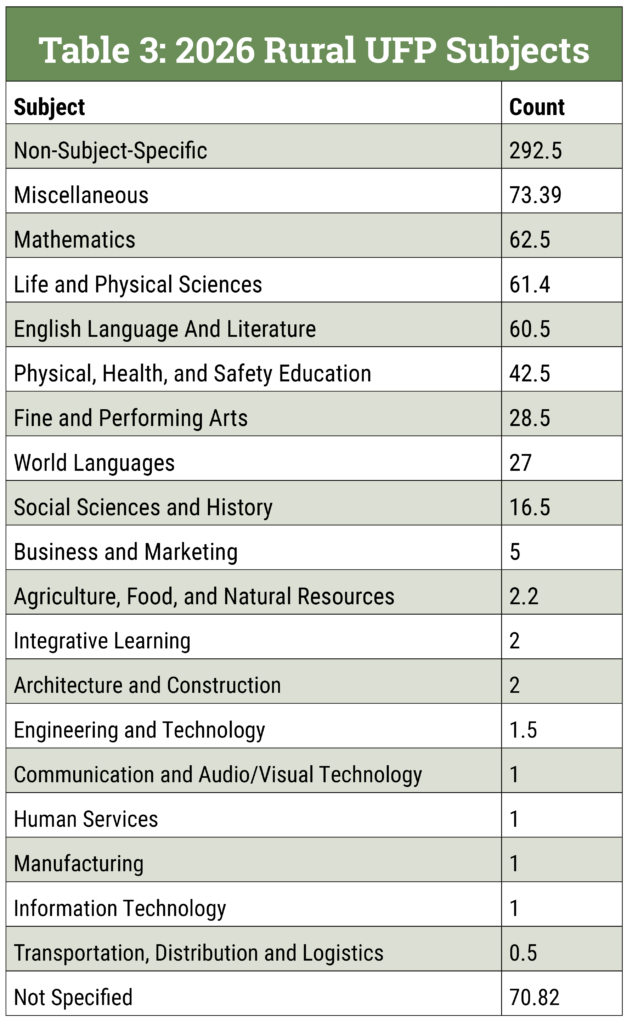
Last, ISBE’s UFP datasheet does not account for the loss of potential positions, such as in career and technical education (CTE). Although the datasheet is a powerful tool that provides invaluable insight into the changing tides of the educator workforce, one of the biggest limitations it carries is the inability to quantify unfilled potential positions that schools do not create because the labor market lacks the supply of qualified teachers despite strong demand from students. CTE is the best example of this. Unlike mandated courses like English, mathematics, and science, CTE is an elective. If a school is unable to hire an English teacher, they cannot simply eliminate a mandated position. The work of that missing teacher might be spread among colleagues at a school, but the district retains the position in hopes of attracting a teacher at some point. However, if a district is unable to attract a CTE teacher for a specific career course, then that district will not offer the course or even create the position in the first place. This disparity is best seen in the breakdown of “Teacher” UFP by subject (Table 3). Although there is a “career and technical educator” subcategory of “Teaching,” the paltry amount of unfilled CTE positions pales in comparison to the overwhelming demand for CTE from students and parents. Take, for instance, “Digital Technology.” The Illinois Department of Employment Security projects that “digital technology” related occupations will be some of the fastest growing careers in Illinois over the next decade with growth expected in every region of the state, yet CTE courses in these careers are some of the least offered in rural schools. Despite this, the ISBE UFP datasheet reports no unfilled position for “Digital Technology” across all 852 public school districts. Rather, the single “Information Technology” position counted by the datasheet is for an elementary IT resource teacher. The same is true for healthcare, energy, hospitality, transportation, agriculture, and all CTE fields: the UFP datasheet is excellent for tracking open positions, but it is unable to relay the loss of potential positions due to a chronically small educator workforce.
Without a doubt, we should celebrate that our various measures at combatting the persistent and pervasive educator shortage might finally be paying dividends in the form of reported unfilled teaching positions decreasing significantly. However, we must remain sober to the fact that serious structural issues remain, and a plain datasheet only on UFP does not tell the full story, especially for rural districts. Now more than ever, we must remain vigilant, and continue to work harder at inspiring and sustaining future generations of passionate, qualified educators. Keep hope, be joyful, and feel all the more encouraged that our efforts might finally be stemming the tide, but be as ready as ever to keep up the fight for high-quality education for each and every Illinois student and community.