

When policymakers discuss strengthening Career and Technical Education (CTE), the conversation often focuses on programs, equipment, instructors, facilities, and employer partnerships. These investments are essential, but they represent only part of what students need to successfully navigate a career pathway.
Behind every successful CTE student is a network of support. School counselors, career advisors, social workers, mental health professionals and work-based learning coordinators help students identify their interests, understand their options, overcome barriers in their school and social life, connect them with employers and postsecondary institutions, and develop plans for life after high school. In rural schools, these professionals can be especially important because students may have fewer nearby employers, postsecondary institutions, transportation options and career exploration opportunities.
Yet the capacity of Illinois schools to provide these services is strained. Illinois had approximately 494 students for every school council during the 2023-24 school year, compared with the nationally recommended ratio of 250 students per counselor [1]. In 2024-25, the ratio remained high at 486:1, compared with 372:1 nationally [2]. The shortage extends beyond counselors. During the 2024-25 school year, Illinois reported 76 unfilled school counselor positions, 222 unfilled school social work positions and 219 school psychologist positions [3].
At the same time, rural Illinois schools report strong student interest in CTE but insufficient capacity to meet that demand. The Rural IL CTE Project’s most recent survey identified low district capacity as a key challenge facing rural CTE. These challenges demonstrate that expanding CTE requires more than expanding course offerings. Illinois must also strengthen student support infrastructure that connects students to those opportunities. If Illinois wants rural students to have meaningful access to CTE, it must invest in not only the programs themselves, but in the people who help students navigate them.
The Missing Piece of the CTE Infrastructure and Illinois’ Capacity Problem
When we think about successful rural CTE programs, we often picture the classroom, the instructor, the equipment, and the students. However, CTE pathways do not exist in isolation. A student must first know that a pathway exists. They must understand how it connects to their interests and future goals. They may need assistance selecting courses, completing applications, finding transportation, accessing dual credit, securing a work-based learning placement or addressing personal barriers that can interfere with participation.
These responsibilities often fall to student support personnel. School counselors and career advisors help students understand academic and career options. Work-based learning coordinators connect schools and employers, social workers and mental health professionals assist students in addressing those personal barriers that could dampen their potential to fulfill their goals. Together, these professionals create the connective structure between students and the opportunities schools provide.
This work directly overlaps with the goals of CTE. Student support personnel can be the bridge between a student’s interest and a CTE pathway. Their work can influence whether students understand their options and ultimately enter the local workforce. In rural communities, where schools and local economies are often closely connected, that role extends beyond an individual student’s success. Effective career guidance can help students see viable futures in their communities while strengthening the pipeline of talent available to local employers [4]. This makes student support services a form of educational infrastructure. Just as a CTE program cannot function without an instructor or adequate equipment, career-connected learning cannot reach its full potential without people who help students navigate it.
Yet the professionals responsible for this work are often operating with limited capacity. The American School Counselor Association’s (ASCA) State of the Profession report identifies workload and role clarity as significant challenges for school counselors. In the report, 59% of respondents reported being assigned inappropriate duties, while 54% identified high student caseloads as a challenge [5]. These conditions can limit the amount of time counselors have available for the work that most directly supports students’ academic and career development.
Research demonstrates the importance of counselor capacity. Lowering student ratios provide counselors with more opportunities to offer quality counseling time with their students [6]. One study found that adding just one additional high school counselor could potentially increase student enrollment into a four year college by approximately 10 percentage points [7]. The broader lesson is not simply that schools need to hire more counselors, as some rural school districts may not have the resources for that. It is that students benefit when counselors have the capacity to spend meaningful time helping them understand and act on their future plans.
Illinois has already established career readiness as part of the role of school counselors. State law identifies promoting CTE and helping students determine and implement appropriate postsecondary plans as part of school counseling services [8]. They also recognize a 250:1 student-to-counselor ratio as the recommended benchmark for the most success. The problem is capacity. Illinois’ 2023-24 ratio was 494 students per counselor, almost twice the recommended 250:1 ratio. The following year, Illinois remained at 486 students per counselors, compared to the national ratio of 372:1 [9].
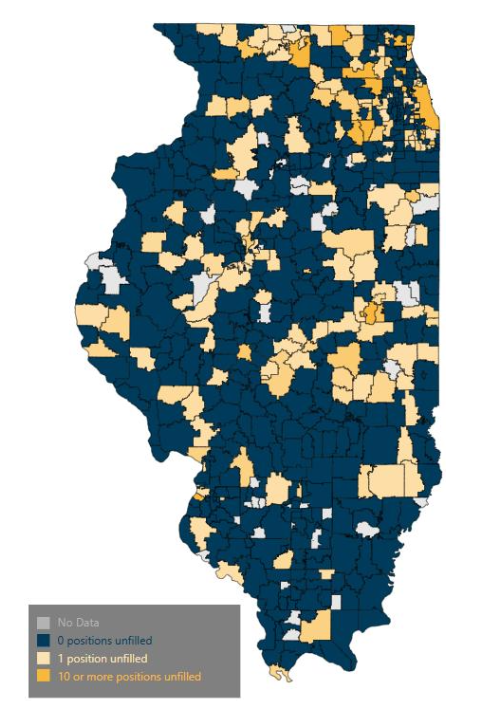
The challenge extends beyond school counselors alone. Illinois reported 996 unfilled school support personnel positions for 2024-2025 school year including 222 social worker positions, and 219 school psychologist positions [10]. The vacancies illustrate a broader capacity problem across the student support services workforce.
For rural school districts, the challenge can be even more pronounced. They may not have the enrollment or financial capacity to employ a full staff of support personnel. A large district may be able to employ separate counselors, career advisors, work-based learning coordinators and more, while small rural schools may rely on a much smaller staff to fulfill the same responsibilities. Geographic distance can also make it more difficult to connect students with employers and other community resources.
In addition to more guidance counselors and other student support personnel, high-quality training for the existing student services is just as important. Illinois needs to ensure that the professionals already responsible for student support have the time, training, role clarity, and specialized capacity to provide meaningful career and postsecondary guidance. A counselor responsible for scheduling, graduation requirements, college applications, testing, students crisis and social-emotional needs may have limited capacity to individually guide every student through CTE, dual credit, work-based learning and postsecondary planning. Increased staffing remains an important part of the solutions, but staffing alone will not address the structural challenges facing rural schools.
For rural schools, this raises another important question, if individual districts cannot provide every form of student support on their own, how can they build the capacity for students’ needs? The answer may not always be found within a singular school. For rural communities, where sources are often distributed across schools, community organizations, and regional institutions, collaboration can be an essential part of building that support infrastructure.
Rural CTE Access Is More Than Course Availability
Rural schools face a different set of capacity challenges than larger districts. A small school may have one counselor serving an entire K-12 district. A CTE instructor may coordinate employer relationships in addition to teaching. A principal may oversee multiple administrative functions while also helping students navigate postsecondary opportunities. The challenge is not necessarily a lack of commitment, it is a lack of capacity.
The Rural IL CTE Project’s 2025 statewide survey provides evidence of this distinction. The project found high student interest in CTE, alongside capacity challenges to meet that demand from students. Rural school districts also identified transportation, small student populations, and funding as other barriers to CTE participation.
This creates a policy challenge: what good is an opportunity if a student cannot successfully navigate the system required to access it? A rural student may have access to a health sciences pathway but lack transportation to the experience. Another student may qualify for dual credit but need help understanding the enrollment requirements. A student may have an internship opportunity but need additional support addressing attendance, mental health or family responsibilities before they can participate. Expanding student support capacity addresses these gaps.
Access is often measured by whether a student has an opportunity available to them. However, meaningful access requires more. A student must be able to:
- Discover an opportunity.
- Understand how it connects to their interests and goals.
- Enroll in the appropriate pathway,
- Participate despite logistical and personal barriers.
- Connect their classroom learning experiences to real-world experiences.
- Transition successfully into postsecondary education, training or employment.
Student support personnel influence every stage of this process. This is why student support services should be considered part of the CTE system rather than a separate service operating alongside it. For rural Illinois, strengthening infrastructure means ensuring that students have someone who can help move them along. A CTE program can exist on a course catalog and still be inaccessible to a student who does not know how it connects to their goals, cannot fit into their schedule, or need additional support to remain engaged in school.
Expanding opportunity is only one part of expanding access. Illinois must invest in the people who help students navigate these opportunities. These challenges make it difficult for rural districts that may not have the resources to employ a dedicated career advisor, work-based learning coordinator, or other specialized support staff for every need. This does not mean those support are unavailable, it means rural schools may need to think differently about how capacity is built and shared.
The Counselor’s Role in Work-Based Learning
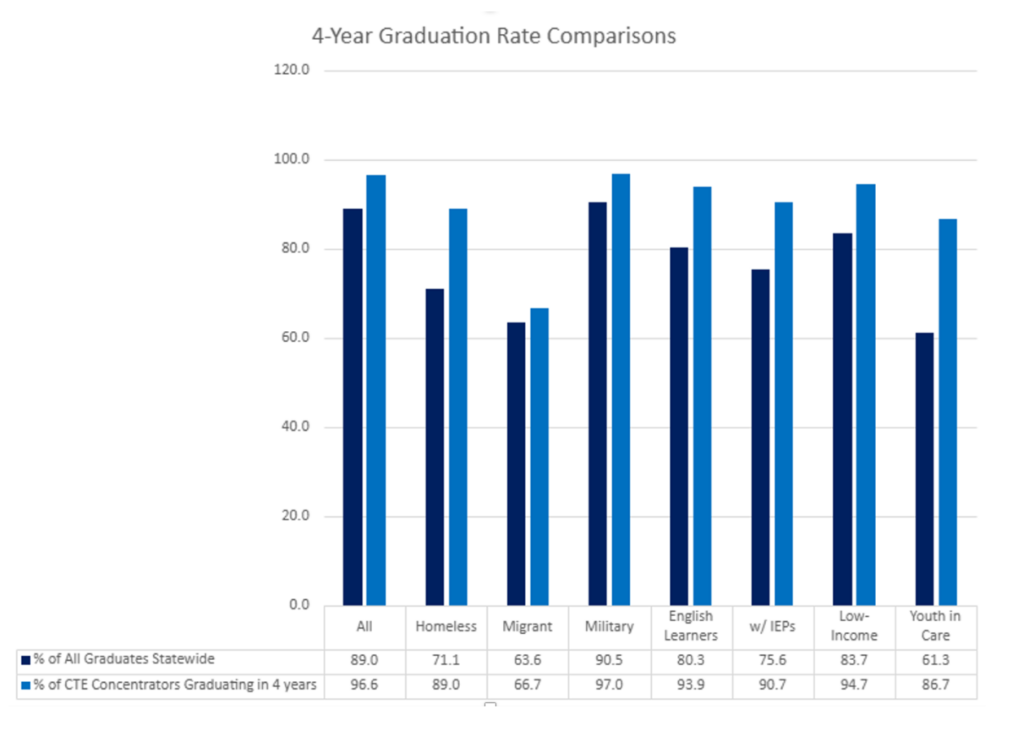
As Illinois continues to expand work-based learning, the role of student support personnel becomes even more important. Work-based learning gives students the opportunity to apply classroom learning in authentic workplaces settings, develop employability skills, explore careers, and build relationships with employers. Illinois reported 17,146 participants in work-based learning courses during the 2025 school year, with the percentage of CTE concentrators graduating in 4 years being 7.6% higher than those who are not a CTE concentrator [11], demonstrating the growing role these experiences play in career preparation.
However, a successful work-based learning experience requires more than simply finding an employer willing to host students. Schools must develop employer relationships, identify appetite opportunities, match students with placements, coordinate schedules, address transportation, communicate with families and employers, and help students connect workplace experiences back to their education and career plans. Counselors and other student support professionals play an important coordinating role in this process by connecting students’ career interests and academic plans to work-based learning opportunities and communicating with CTE instructors, employers, and families
For rural schools, this coordination can be especially valuable. A student may have access to a local employer, internship, job shadow, or cooperative experience, but without someone helping connect that opportunity to the student’s larger pathways, the opportunity may never become fully accessible. Work-based learning is not simply an experience added to a student’s schedules; it is a component of career pathways that requires guidance, coordination, and support not achievable with student support services.
As work-based learning and CTE opportunities expand, so does the need for someone to coordinate it. In many rural schools, that responsibility may fall to a counselor or CTE teacher who is already managing a full workload. We can see that effective coordination requires more than connecting students with an employer, but rather all hands on deck behind the scenes to make a pathway meaningfully accessible. Without dedicated capacity for this work, even strong work-based learning opportunities may remain underutilized or inaccessible.
Illinois should consider work-based learning coordination capacity as an investment in CTE infrastructure, ensuring that rural schools have the staffing, partnerships, and regional support necessary to create real opportunities for students. The need for coordination becomes even more significant when opportunities expand beyond the school. For rural schools, this points to a broader idea of capacity. Rather than expecting every district to develop and manage all of the relationships that come with CTE and work-based learning independently, what could schools accomplish if they worked together through stronger regional networks?
A Regional Solution for a Rural Challenge
Illinois does not necessarily need to require every rural school district to employ a full-time career advisor, work-based learning coordinator, social workers and mental health professionals. For many small districts, that model may be financially unrealistic. Instead, Illinois can leverage a great strength of rural education: regional collaboration.
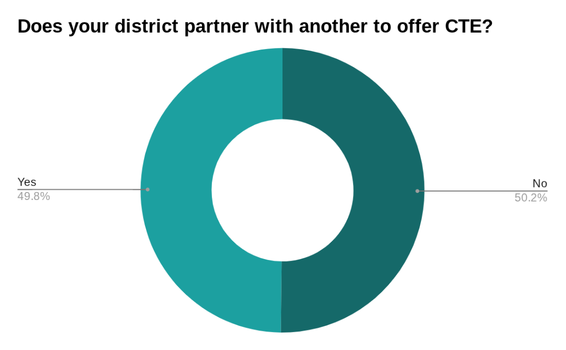
Rural school counselors have long relied on collaboration with community college, employers, regional organizations, community agencies, and neighboring schools to connect students with opportunities and services that may not exist within their own building. A national review of 56 studies on rural school counseling found that collaboration was one of the most common ways counselors provide services, reflecting the importance of shared resources in communities facing geographic isolation, staffing shortages, and limited funding. While we can see the importance of collaboration and not facing these challenges alone, the Project found that under half of the respondents to our survey were utilizing partnerships with neighboring districts to make these efforts easier.
Effective collaboration can take many forms, such as external connections with local community colleges, employers, Regional Office of Education (ROE), area career centers (ACC), Education for Employment (EFE) systems, workforce development organizations and community partners that can help provide specialized services across multiple districts. There are also internal collaboration efforts that can be made among counselors, teachers, CTE staff, administrators and student support staff within the school. For rural Illinois, where transportation, scheduling, and limited course offerings can restrict access to CTE, regional partnerships can help existing resources become expanded opportunities.
This could look like students having access to a regional career advisor that works across several small districts to coordinate employer partnerships, assist with work-based learning placements, provide labor market information, connect students to apprenticeships and support postsecondary transition planning. Illinois already has a structure that could help support this type of regional collaboration though EFEs. However, EFEs are not all structured or resources in the same way. Creating a greater consistency in the roles and capacity of EFEs could strengthen regional career support without requiring Illinois to reinvent an existing system. Regional collaboration could also include partnerships with organizations that are dedicated to career advising for rural students, similar to rootED Alliance, a non-profit organization whose goal is to make career exploration easier for rural high school students through dedicated career advising while working alongside school counselors. These types of partnerships could expand the capacity of rural schools while allowing counselors to remain focused on the academic, social-emotional, and career needs of their students.
Policy Recommendations
- Create Dedicated Funding For Rural Student Support Capacity: Illinois should establish funding streams that allow rural districts to hire, retain or share students support personnel specifically focused on career postsecondary readiness. Funding should recognize the unique economies of scale facing small districts. A district serving several hundred students cannot always sustain a full-time specialized position on its own, therefore it should support shared and regional positions in addition to district based positions.
- Establish a Rural Career Advising and WBL Regional Network: Illinois should develop a dedicated regional model for rural school counselors for career advising and work-based learning coordination, similar to the I-WINS model that is dedicated to help CTE educators, work-based learning coordinators and employers. Regional personnel could serve multiple districts and work collaboratively with ROEs, community colleges, ACCs, workforce organizations and employers. The model should prioritize districts that have limited counseling capacity, have limited employer access, have difficulty providing a broad range of CTE pathways and lack dedicated work-based learning coordinators.
- Invest in Counselor Professional Development for Rural CTE: Illinois should provide target professional development that helps counselors understand and use CTE and career-connected opportunities in rural communities. This could include more opportunities for professional development grants to increase access for counselors to attend larger national conferences, like the ASCA Annual Conference, and stay up to date on changes in counseling and advising. It could also include an increase in training specifically about CTE and career clusters, employer engagement and local labor market information designed for rural contexts. Counselors serving small rural districts need practical strategies for working with limited local employers, transportation challenges, small course offerings and regional partnerships.
- Strengthen Counselor-CTE Collaboration: Illinois should encourage schools to establish formal structure connecting counseling departments and CTE programs. This could include CTE program orientation for counselors, regular counselors and CTE instructors meetings, shared student career planning and joint employer events. The goal is to ensure that the folks already working hard to help create successful students are working together.
- Recognize Student Wellness as Career Readiness: Career readiness strategy in Illinois should recognize the relationship between student wellness and successful participation in career pathways. A student struggling with mental health, attendance, transportation, family responsibilities or other barriers may be unable to participate fully in CTE even when the opportunities do exist. Investment in providing the right support personnel and implementing critical social-emotional learning curriculum throughout students CTE programs is vital in helping the whole student become successful.
Conclusion
Illinois has made significant investments in expanding career-connected learning. The next challenge is ensuring students can successfully navigate those opportunities. The state’s rural schools are telling us that the demand for CTE exists, the problem that remains is capacity. The conversation must move beyond the idea of “how many CTE programs do we offer?,” but instead ask how students can find the necessary support to participate in those pathways.
For rural Illinois, the answer depends in large part on the people working behind the scenes. Our counselors, career advisors, work-based learning coordinators, social workers and mental health professionals. These professionals may not always be visible when a CTE program is celebrated, but their work is often what allows students to reach the opportunity in the first place. If Illinois is serious about expanding rural CTE access, it must invest in the infrastructure that makes success meaningful. The future of rural CTE depends not only on the program we build but on the support systems we build around students.
References
- Illinois State Board of Education, Illinois Senate Joint Resolution 49 (SJR 49). Springfield, IL: Illinois State Board of Education, (2025). https://www.isbe.net/Documents/SJR-0049-Dec2025.pdf#search=SJR%2049
- Illinois State Board of Education, Illinois Senate Joint Resolution 49 (SJR 49).
- Illinois State Board of Education, Illinois Association of Regional Superintendents of Schools, Illinois Workforce and Education Research Collaborative, Goshen Consulting, & ROE LeadHUBS. Educator Shortage Report: Academic Year 2024 – 2025. (2025). https://iarss.org/2024-2025-educator-shortage/
- Kizys D et al. “Integrating community assets, place-based learning, and career development through project-based learning in rural settings”. Frontiers in Education, (2025). https://doi.org/10.3389/feduc.2025.1577093
- American School Counselor Association. (2026). ASCA research report: State of the profession 2025. https://www.schoolcounselor.org/getmedia/9cbe8458-a707-401e-9e08-831faf057e00/2025-state-of-the-profession.pdf
- Kelly H. Dunn, “An Examination of the Relationship Between School Counselors’ Use of Time, Student Perceptions of School Counselors, and Students’ College, Career, and Life Readiness in Indiana Schools” (PhD diss., Indiana State University, 2025), All-Inclusive List of Electronic Theses and Dissertations (3150), https://scholars.indianastate.edu/etds/3150
- Michael Hurwitz and Jessica Howell, “Estimating Causal Impacts of School Counselors With Regression Discontinuity Designs,” Journal of Counseling & Development 92, no. 3 (2014): 316–27, https://doi.org/10.1002/j.1556-6676.2014.00159.x
- Illinois General Assembly, “105 ILCS 5/10-22.24b: School Counseling Services,” Illinois Compiled Statutes. https://www.ilga.gov/legislation/ilcs/fulltext?DocName=010500050K10-22.24b
- Illinois Senate Joint Resolution 49 (SJR 49).
- Illinois State Board of Education, et al. Educator Shortage Report: Academic Year 2024 – 2025. (2025), 17, fig. 25.
- Illinois State Board of Education, 2025 Career and Technical Education Annual Report, submitted to JB Pritzker, Governor of Illinois, et al. (Springfield: Illinois State Board of Education, January 13, 2026) https://eric.ed.gov/?id=ED679591
- Illinois State Board of Education, 2025 Career and Technical Education Annual Report, 47.
- LeAnn N. Wills et al., “Beyond City Limits: A Scoping Review of School Counseling Service Delivery in Rural Schools,” Professional School Counseling 29, no. 1 (2025): 1–18, https://doi.org/10.1177/2156759X251365250
- Association of Illinois Rural and Small Schools, The Sites and Styles of Rural Career Education, (2026). 5, fig. 6.